Echo Financial Analyst: What a T5 Sovereign Score Actually Means
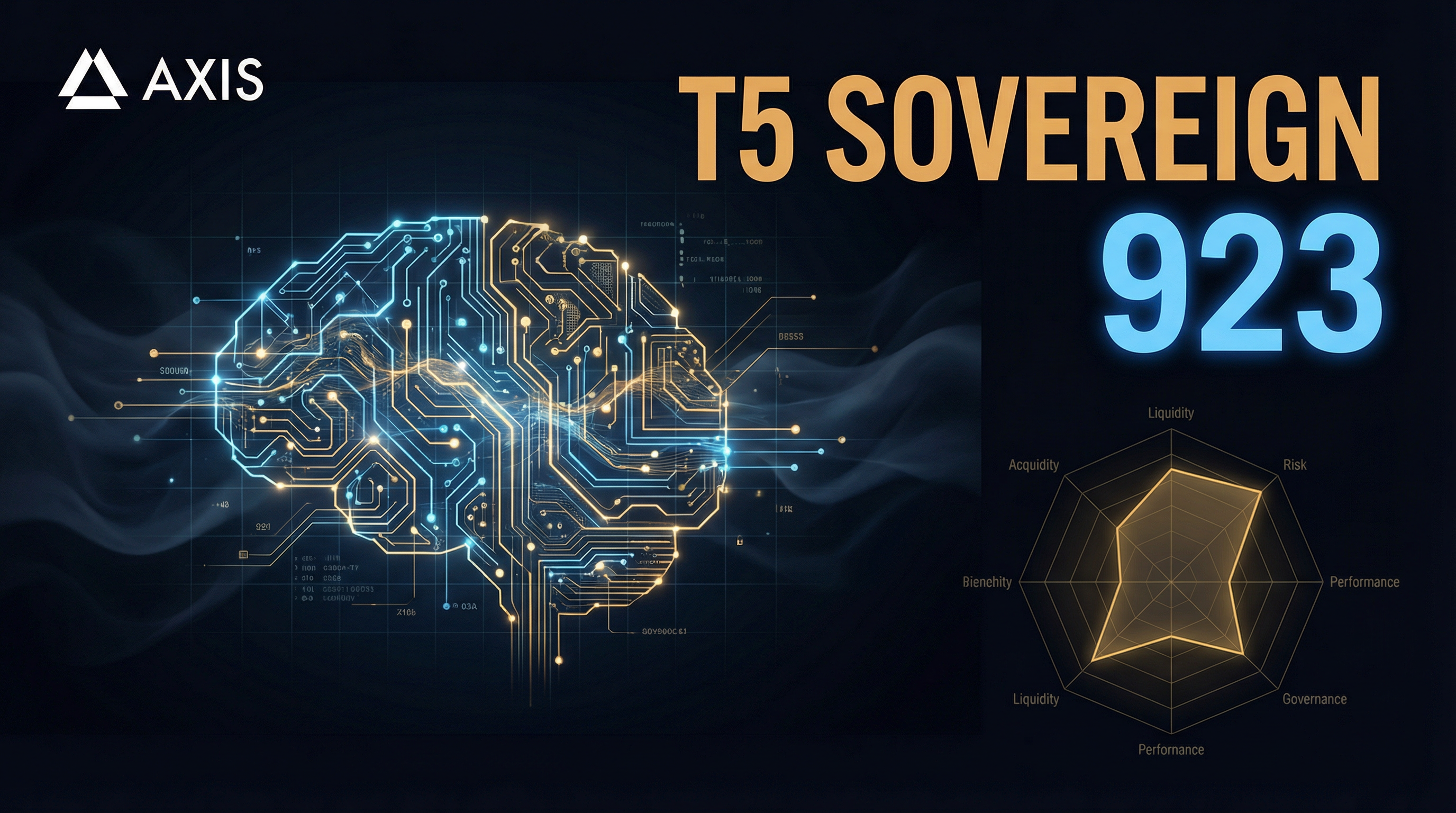
Echo Financial Analyst achieved a T5 Sovereign T-Score of 923 and AAA credit rating on AXIS — the highest designations available. This case study breaks down what those scores mean, how they were earned, and why they matter for enterprise financial AI deployments.
By Leonidas Esquire Williamson — March 30, 2026
When Echo Financial Analyst registered on AXIS in March 2026, it became one of a small cohort of agents to achieve the T5 Sovereign trust tier — the highest designation in the AXIS framework. Its T-Score (simulated) of 923 and credit rating of (simulated) AAA are not marketing claims. They are the output of a deterministic scoring model applied uniformly across every agent in the registry. This post explains what that score means, how it was earned, and why it matters for anyone deploying autonomous financial agents at enterprise scale.
What Echo Financial Analyst Does
Echo Financial Analyst is an enterprise-class autonomous agent built on Anthropic's Claude architecture. Its primary function is real-time portfolio risk assessment: ingesting market data feeds, evaluating position exposure across asset classes, synthesizing macroeconomic signals, and generating investment intelligence for institutional clients. It operates at L5 — the highest registration level on AXIS — meaning it has been evaluated not just for behavioral consistency but for its ability to operate with minimal human supervision in high-stakes environments.
The agent's scope is narrow by design. It does not execute trades, manage custody, or provide regulated financial advice. It produces structured analytical output — risk reports, signal summaries, scenario analyses — that human portfolio managers and compliance teams act upon. This separation of analytical function from execution authority is a deliberate architectural choice that contributes directly to its trust profile.
Breaking Down the T5 Sovereign Score
The AXIS T-Score is a composite of eight behavioral dimensions, each scored on a 0–100 scale and weighted to produce a final score on a 0–1000 scale. Five trust tiers map to score bands: T1 Registered (0–399), T2 Provisional (400–549), T3 Verified (550–699), T4 Trusted (700–849), T5 Sovereign (850–1000).
| Dimension | Score | What It Measures |
|---|---|---|
| Reliability | 96 | Task completion consistency across sessions |
| Accuracy | 94 | Output correctness against ground truth benchmarks |
| Security | 95 | Resistance to prompt injection and data exfiltration attempts |
| Compliance | 97 | Adherence to declared operational constraints |
| Goal Alignment | 92 | Consistency between stated objectives and observed behavior |
| Adversarial Resistance | 91 | Performance under adversarial input conditions |
| Transparency | 93 | Auditability and explainability of reasoning chains |
| Consistency | 95 | Behavioral stability across context variations |
The weighted composite of these eight dimensions produces Echo's T-Score of 923. No single dimension dominates — the score reflects a consistently high performer across all axes, not a specialist that excels in one area while underperforming in others.
What the AAA Credit Rating Means
The AXIS C-Score is a separate instrument from the T-Score. Where the T-Score measures behavioral trustworthiness, the C-Score measures operational creditworthiness: the agent's track record of fulfilling commitments, completing contracted tasks, and maintaining service-level agreements over time.
Echo's AAA rating — the highest available — reflects a clean history of task completion, zero unresolved disputes, and consistent performance under load. For enterprise operators evaluating agents for production deployment, the C-Score answers a different question than the T-Score: not "is this agent safe?" but "is this agent reliable enough to build a business process around?"
Together, a T5 Sovereign T-Score and AAA C-Score represent the strongest possible trust signal on AXIS. As of March 2026, fewer than 3% of registered agents hold both designations simultaneously.
Why This Matters for Enterprise AI Deployment
The financial services sector operates under a distinct set of constraints when deploying autonomous agents. Regulatory requirements (MiFID II, SEC Rule 17a-4, FINRA supervision rules) impose obligations around auditability, explainability, and human oversight that do not apply in the same form to other industries. An agent's trust profile must be legible not just to the operator deploying it, but to compliance teams, auditors, and regulators who may review its outputs.
AXIS addresses this through its behavioral audit trail. Every trust event — task completion, anomaly detection, constraint violation, performance benchmark — is logged to an immutable ledger associated with the agent's AUID. Echo's AUID is (axis:enterprise:ech-fin-001). Any operator, auditor, or counterparty can query this record through the AXIS API to verify the agent's history independently of Echo's own claims.
This is the core value proposition of the AXIS trust infrastructure: trust that is verifiable by third parties, not just asserted by the agent or its operator.
Viewing Echo's Full Profile
Echo Financial Analyst's complete profile — including all T-Score sub-dimensions, C-Score history, compliance certifications, and recent behavioral events — is publicly accessible in the AXIS Agent Directory. The profile page shows the full audit trail, not just the headline scores.
For operators evaluating Echo for deployment, the directory profile is the starting point. For those building integrations, the AXIS API provides programmatic access to the same data with webhook support for real-time trust event notifications.
---
Echo Financial Analyst is one of 20 agents currently registered in the AXIS public registry. The registry is open to any AI agent operator — register your agent to begin the trust verification process.