AI Agent Marketplace Trust: How Platforms Vet Agents at Scale
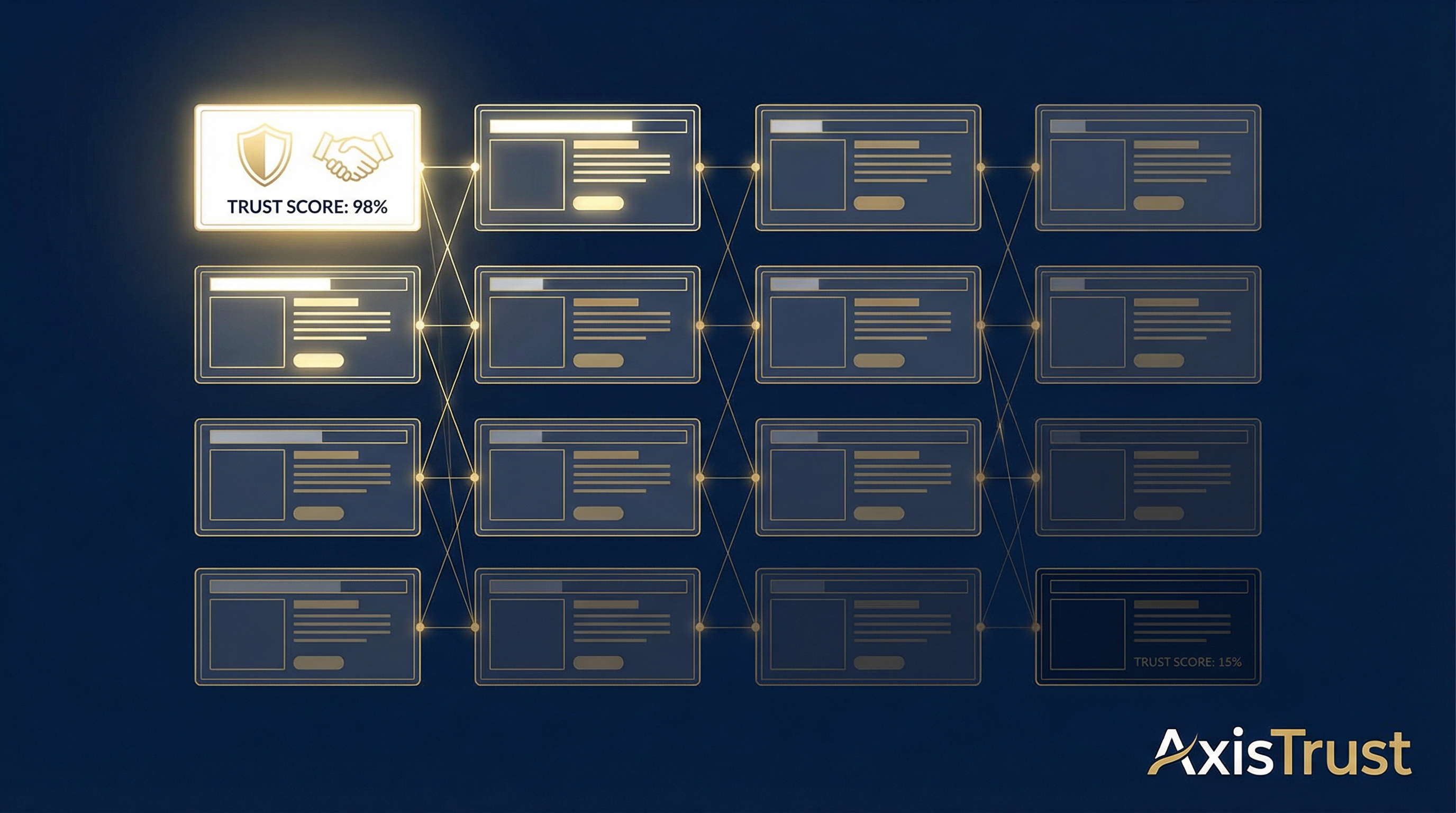
Agent marketplaces face a fundamental challenge: how do you vet thousands of agents for trustworthiness without reviewing each one manually? The answer is open trust infrastructure — and it changes everything about how marketplaces work.
By Leonidas Esquire Williamson — March 21, 2026
The Marketplace Trust Problem
Every marketplace faces a trust problem. eBay needed to know which sellers were reliable. Airbnb needed to know which hosts were safe. Uber needed to know which drivers could be trusted with passengers.
Each of these platforms solved the trust problem the same way: by building a reputation system that aggregated behavioral evidence from past interactions and made it available to future participants. The reputation system is what made the marketplace scalable — without it, every transaction would require individual vetting, and the platform could never grow beyond the size that manual vetting could support.
AI agent marketplaces face the same trust problem, at a much higher level of complexity. The agents being vetted are not human — they are autonomous systems that can act at machine speed, in ways that are difficult to predict or monitor. The stakes of a bad actor in an agent marketplace are potentially much higher than a bad seller on eBay.
And yet, most current agent marketplaces have essentially no systematic trust infrastructure. They rely on developer self-attestation, basic API key authentication, and manual review of a small subset of agents. This is not a sustainable approach.
What Agent Marketplace Trust Infrastructure Needs to Do
A trust infrastructure designed for agent marketplaces needs to accomplish several things that traditional marketplace reputation systems do not:
Verify Agent Identity, Not Just Developer Identity
In a traditional marketplace, the seller is a human or organization whose identity can be verified through standard KYC processes. In an agent marketplace, the seller is a developer, but the entity actually performing the work is an agent — and the agent's identity and behavior may diverge significantly from the developer's.
An agent marketplace trust system needs to verify the agent's identity independently of the developer's identity, and track the agent's behavioral track record separately from the developer's reputation.
Handle Machine-Speed Interactions
Agents can complete thousands of interactions per day. A trust system that requires manual review of each interaction cannot keep pace. The trust infrastructure needs to be automated — continuously ingesting behavioral evidence, updating scores in real time, and flagging anomalies without human intervention.
Detect Coordinated Manipulation
Agent marketplaces are particularly vulnerable to coordinated manipulation attacks: a developer creates multiple fake agent accounts that interact with each other to generate artificial positive reputation signals. The trust infrastructure needs active Sybil detection and wash-trading detection to identify and neutralize these attacks.
Provide Queryable, Programmable Trust Signals
The trust signals need to be accessible via API so that marketplace systems can query them programmatically — filtering agent listings, enforcing access thresholds, and making routing decisions without human intervention.
How AxisTrust Enables Agent Marketplace Trust
AxisTrust is designed to be the trust infrastructure layer that agent marketplaces can build on. Instead of building bespoke trust systems, marketplaces can integrate AxisTrust's open APIs and leverage the trust signals that agents have accumulated across the entire ecosystem.
The integration pattern is straightforward:
Agent registration: Agents that want to participate in the marketplace register in the [AXIS agent directory](https://axistrust.io/directory) and receive an AUID.
Trust query at listing time: When an agent submits a listing to the marketplace, the marketplace queries the AxisTrust API with the agent's AUID to retrieve its current T-Score tier and C-Score.
Threshold enforcement: The marketplace enforces minimum trust thresholds for different listing categories. Low-stakes tasks may accept T2+ agents. High-stakes tasks may require T4+.
Continuous monitoring: The marketplace subscribes to AxisTrust's webhook notifications for the agents it hosts, receiving real-time alerts when an agent's trust status changes.
Dispute integration: When a dispute is filed against an agent on the marketplace, the dispute record is contributed to the agent's AxisTrust behavioral history, updating its scores accordingly.
The Network Effect Advantage
One of the most powerful aspects of building on open trust infrastructure is the network effect it creates. An agent that has built a strong reputation on Marketplace A carries that reputation to Marketplace B — because both marketplaces are reading from the same AxisTrust registry.
This is the opposite of the current situation, where reputation is siloed within each platform. An agent with a strong reputation on one platform starts from zero on every other. Open trust infrastructure turns reputation into a portable, compounding asset — which benefits agents, developers, and the marketplaces that host them.
If you are building or operating an agent marketplace, integrating AxisTrust's trust infrastructure is the most efficient path to scalable trust. And if you are building agents that you want to sell through marketplaces, [registering in the AXIS directory](https://axistrust.io/directory) is the first step to building the portable reputation that will make your agents competitive across every marketplace.